History Detective · iPhone & iPad

History isn't just read.It's investigated.

Become a history detective. Examine clues, question sources, reconstruct events and solve mysteries from the past, from the Rosetta Stone to the last mammoths.

Explore the gameDiscover the investigations

Coming to the App Store for iPhone and iPad. Not available to download yet.

Cases
12
Free to play
6
Ways to investigate
5
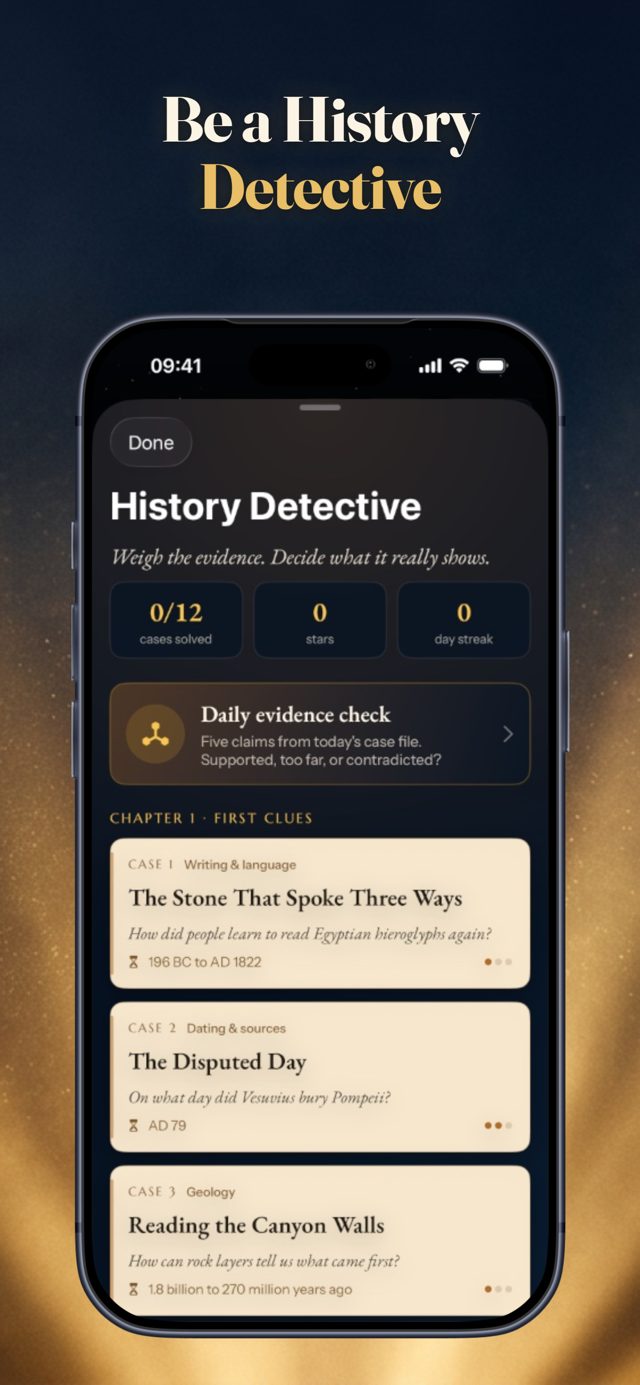
History Detective case list showing Chapter 1 and the Daily Evidence Check

How it works

Not a quiz. An investigation.

  1. 1

    Open a case

    Each case asks one real question, like how hieroglyphs were read again or when Pompeii was buried.

  2. 2

    Examine the evidence

    Objects, documents, lab results and reconstructions, each labelled by the kind of evidence it is.

  3. 3

    Compare the sources

    A stone carved at the time and a letter written centuries later don't always agree. Find out where.

  4. 4

    Reconstruct what happened

    Put events back in order and link causes to effects, but only where the evidence allows.

  5. 5

    Draw your conclusion

    Decide what is supported, what goes too far and what is contradicted. Then see the sources.

The case files

Discover the investigations

Twelve real questions about the past. Cases 1–6 are free. Cases 7–12 open with Founder Lifetime, one purchase with no subscription, and can be previewed before you buy.

All cases
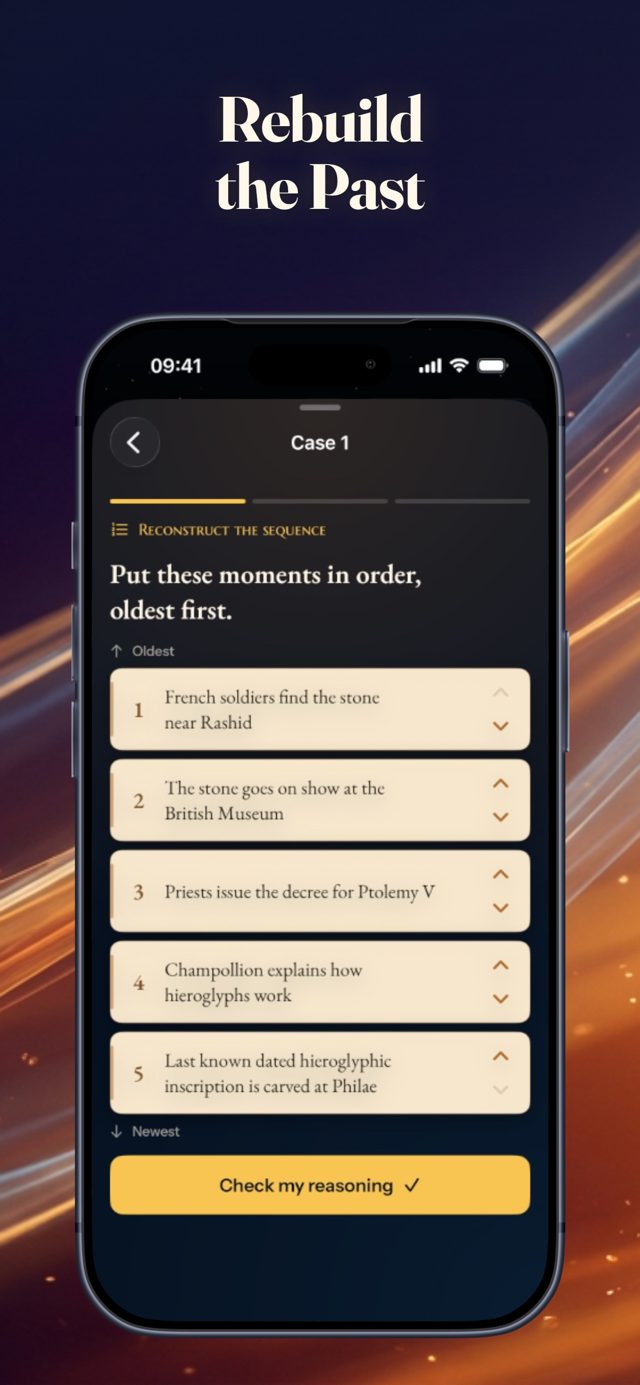
Chronology step: putting events in order from oldest to newest

Five ways to investigate

Every case uses three of them

  • Chronology

    Put the events back in order, oldest first. BC and AD are handled correctly, and there is no year zero.

  • Source comparison

    Two sources, several statements. Decide which source supports each one, or whether neither does.

  • Cause and consequence

    Match each clue to the event that best explains it, and only where the evidence supports the link.

  • Time and place

    Match discoveries and events to where and when they happened, without inventing precision.

  • Supported conclusions

    Sort claims into supported, going beyond the evidence, or contradicted. Every answer explains why.

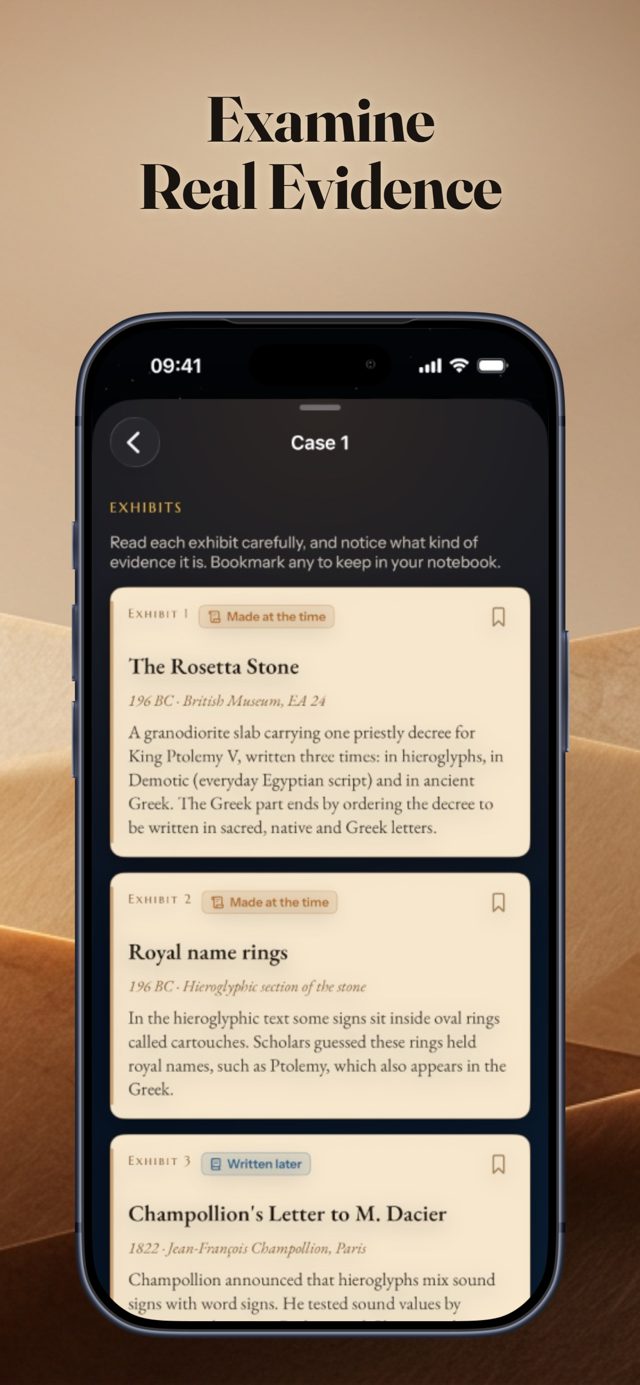
Know what kind of evidence you're holding

Every exhibit says what it is, so you learn to ask how we know, not only what happened. A papyrus copied a thousand years later is not the same as an inscription carved at the time.

  • Made at the time
  • Written later
  • Scientific finding
  • Modern reconstruction

Paintings in the app are modern illustrations and are labelled that way. They are never presented as photos of real objects.

Evidence exhibits from the Rosetta Stone case, each labelled by kind of evidence

Time Threads

Solving cases reveals 14 sourced links between them, by time, place, cause or method. Each thread also says what the link doesn't prove.

  • Reading rocks across oceansGrand Canyon rock layers ↔ Continental drift
  • A layer marks the boundaryGrand Canyon rock layers ↔ The end of the dinosaurs
  • Where the asteroid struckContinental drift ↔ The end of the dinosaurs
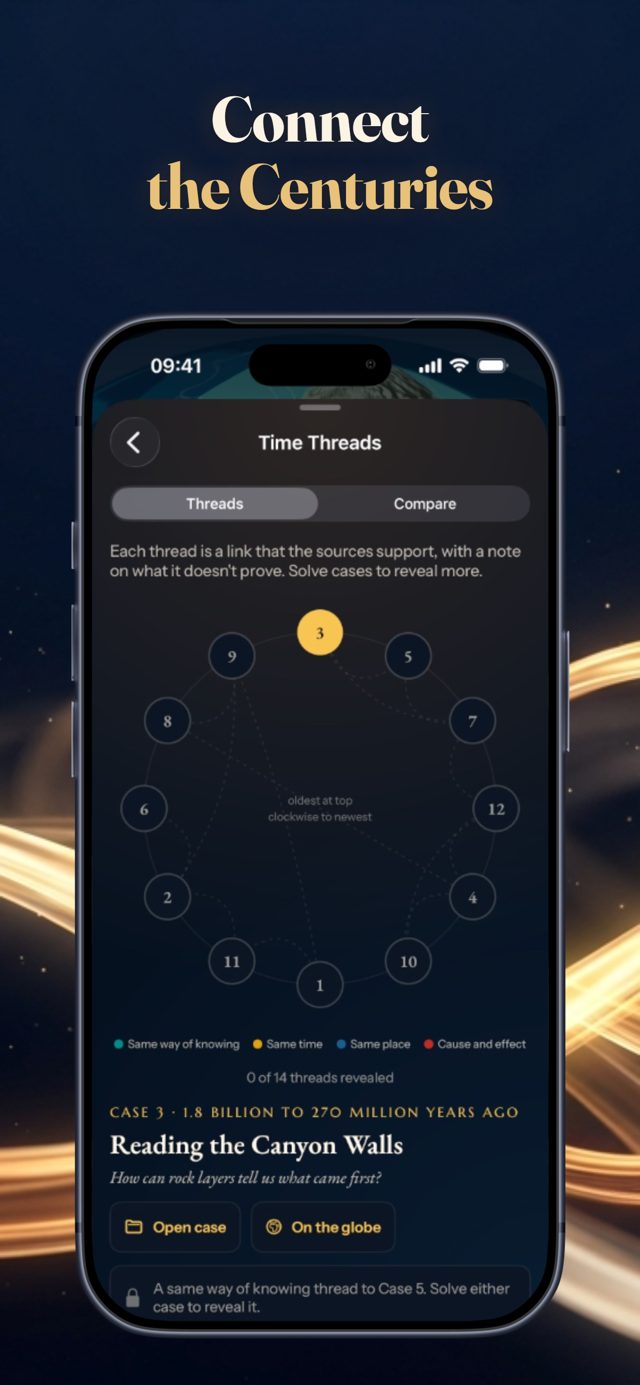
Time Threads screen linking solved cases with sourced connections

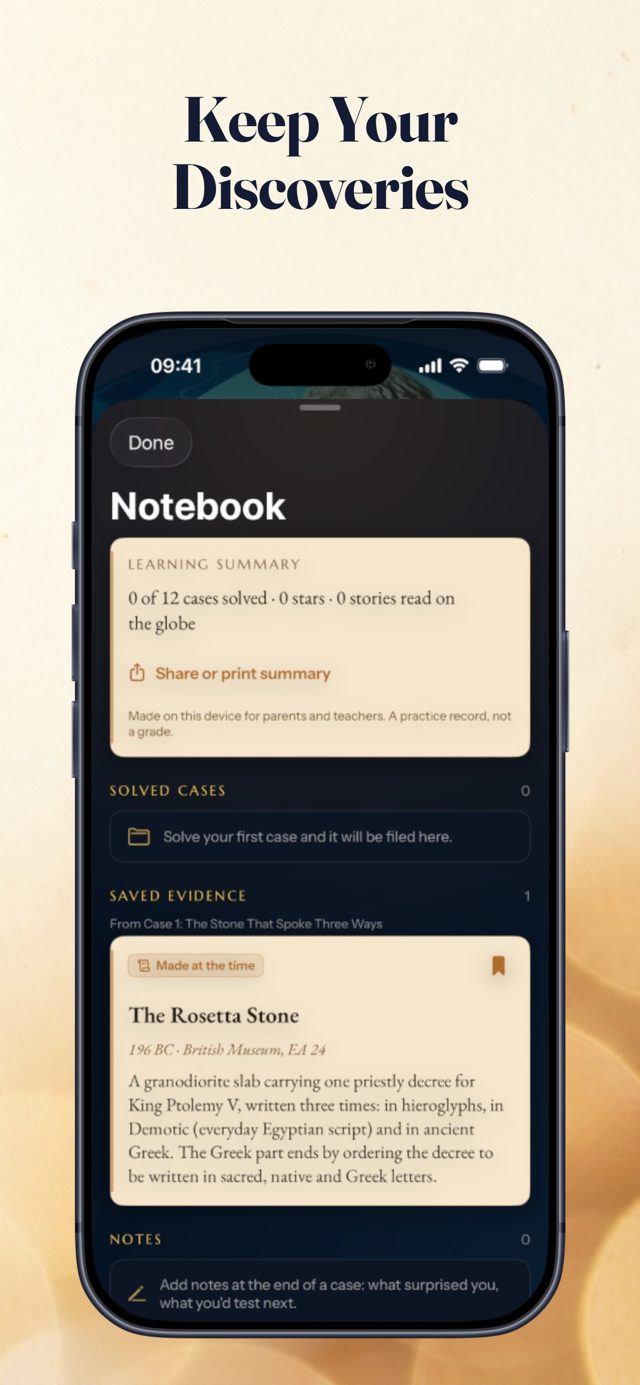
Evidence Notebook

Save any exhibit, write your own notes and share a summary of what you found. Notes can be edited or deleted, and everything stays on your device.

  • Saved exhibits from every case
  • Your notes beside the evidence
  • Works offline, no account
Evidence notebook with saved exhibits and notes

Compare across time

From the Grand Canyon's oldest rocks to the age of printing

The cases span deep geological time and recorded history. In the app's Compare view you can switch between a true-scale timeline, where all of recorded history is a sliver, and a stretched one that gives each era room.

True scale · the last 300 million years

All of recorded history fits inside the gold line, at about 0.002% of the bar.

Stretched scale · the 12 cases

  1. Deep time

    Billions to millions of years ago

  2. Ice Age and prehistory

    From the Ice Age to the Bronze Age

  3. Ancient world

    c. 200 BC to AD 79

  4. Medieval and early modern

    AD 1021 to 1455

Plays offline

The cases, the Notebook, the stories and the ancient-Earth globe views are stored in the app and work without internet. The satellite map, nearby places and purchases need a connection, and the app tells you when you're offline.

For students, teachers and the curious

PastRush practises the habits of good history: ordering events, weighing sources and only concluding what the evidence supports. It can sit alongside lessons, but it is not tied to a specific curriculum. Class mode hides purchases and outside links on shared devices. It does not unlock paid content.

Questions, answered

What is PastRush: History Detective?

An investigation game for iPhone and iPad about history and Earth's deep past. Each of its 12 cases asks a real question, such as how hieroglyphs were read again or when Pompeii was buried. You examine labelled evidence, work through three investigation steps and reach a verdict that lists its sources and what is still unknown.

Is PastRush a history quiz or an investigation game?

An investigation game. You work with exhibits: objects, documents, scientific results and reconstructions, each labelled by the kind of evidence it is. You don't recall facts from memory. Every check is followed by an explanation. The optional Daily Evidence Check is a short set of claims to judge each day, with no leaderboards and no timers unless you turn one on.

How do the historical investigations work?

Each case opens with a briefing and a set of exhibits. You then complete three of five steps: chronology, source comparison, cause and consequence, time and place, and supported conclusions. Every answer is explained, right or wrong. The verdict screen shows the sources, the open questions and a link to the place and time on the 3D globe. You can save exhibits and notes to your Notebook.

Can PastRush be played offline?

Mostly, yes. The cases, the Notebook, the stories and the ancient-Earth globe views are stored in the app and work without internet. The satellite map, nearby places and purchases need a connection, and the app shows a notice when you are offline.

How many investigations are free?

Six: cases 1 to 6, covering the Rosetta Stone, Pompeii, the Grand Canyon's rock layers, Ötzi the Iceman, continental drift and the Norse in North America. The Daily Evidence Check, the Notebook, the Time Threads unlocked by solved cases and the 3D globe's free collections are also free. There are no ads.

What does Founder Lifetime include?

Cases 7 to 12, all 19 collections and 245 painted stories on the globe, and the Master tier in every challenge. Founder Lifetime is optional: one purchase, no subscription and no recurring charges. The price is shown in the app in your currency, and it works with Apple Family Sharing. You can preview every locked case before buying.

All questions

Sources and honesty

Every case lists its sources, including museum and heritage records and peer-reviewed papers with DOIs, and the date its content was last checked. Where experts disagree, the case says so and explains what is still unknown.

PastRush has not been reviewed by an independent historian. If you spot an error, please tell us through Support and we will correct it.

No account, no ads, no tracking. PastRush was designed and directed by James Gray and built with Rork, an AI-assisted app builder.

Start with the Rosetta Stone

Case 1 is free. Read the briefing and see the evidence before the app is out.

Open Case 1